

If you’ve been living with chronic pain, you’ve probably tried everything: medications, injections, physical therapy, stretching routines, supplements, perhaps even surgeries. Yet for many people, the pain keeps coming back—or never leaves at all.
That’s where Pain Reprocessing Therapy (PRT) is changing the conversation. Backed by emerging neuroscience and compelling clinical evidence, PRT helps people understand and retrain how their brain and nervous system create chronic pain. And the results are giving many long-term pain sufferers something they haven’t felt in a long time: hope.
Understanding Primary Chronic Pain
Before diving into PRT, it helps to understand a crucial concept: primary chronic pain.
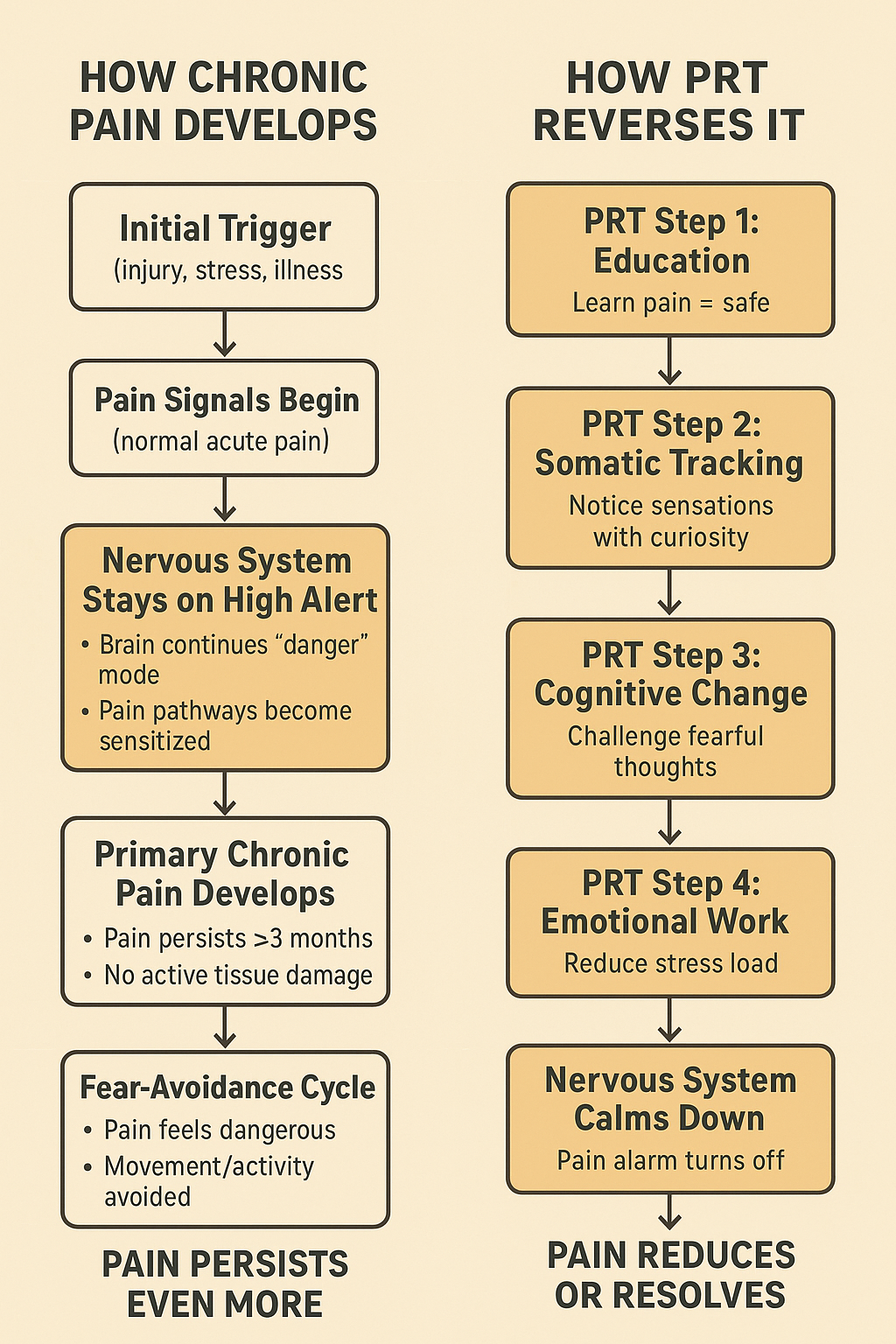
Primary chronic pain is pain that lasts for more than three months and cannot be fully explained by ongoing injury or disease. That doesn’t mean the pain is “imagined” or “in your head.” The pain is very real—but the problem lies in a misfiring alarm system, not in damaged tissues.
This type of pain is sometimes called:
Nociplastic pain
Centralized pain
Or, more simply: pain caused by the brain’s overprotective responses
Common examples include chronic low back pain (without major structural findings), fibromyalgia, IBS, chronic headaches, TMJ pain, and many pelvic pain syndromes.
In these conditions, the nervous system becomes sensitized, interpreting normal or mild sensations as painful—similar to a car alarm going off when the wind blows.
What Is Pain Reprocessing Therapy?
Pain Reprocessing Therapy is a short-term psychological treatment designed to help people retrain the brain to correctly interpret safe body signals and turn down the volume on pain.
Think of it as teaching your nervous system, “You’re safe now. You can stand down.”
PRT has five main components:
1. Pain Education
You learn how the brain generates pain—and how chronic pain often continues long after tissues have healed. Understanding that pain can be “real but not dangerous” helps reduce fear and the brain’s threat response.
2. Somatic Tracking
This is a gentle, non-judgmental way of noticing sensations in your body with curiosity rather than fear. When the brain sees that the body is safe, it starts to deactivate the pain alarm.
3. Cognitive Reframing
PRT helps you identify unhelpful beliefs (“My spine is fragile,” “I’m going to make it worse”) and replace them with accurate, calming interpretations that support healing.
4. Emotional Processing
Stress, unresolved emotions, and past experiences can heighten the nervous system’s sensitivity. Processing emotions safely helps the body move out of “danger mode.”
5. Approach, Not Avoidance
PRT encourages a gradual return to normal activities and movements. Each successful step teaches the brain that the body is safe—further reducing pain.
What Does the Research Say?
One of the most influential studies, published in JAMA Psychiatry in 2021, found remarkable results:
66% of participants receiving PRT were pain-free or nearly pain-free after just four weeks.
Improvements were maintained at a one-year follow-up.
For many people with chronic back pain, this was a level of relief they had never experienced before.
Who Can Benefit?
PRT is especially helpful for people whose pain:
Has persisted for months or years
Moves around or fluctuates
Isn’t fully explained by imaging or medical tests
Gets worse during stress
Appears even without significant physical triggers
It’s not designed for pain caused by clear structural injury, cancer, infections, or active inflammation. But for nervous-system-based pain, PRT can be transformative.
Why PRT Feels Different
Many chronic pain treatments focus on the body—massaging muscles, adjusting joints, reducing inflammation. PRT focuses on the source of the pain alarm: the brain and nervous system.
Instead of battling the pain, PRT helps you build a new relationship with it—one based on safety, understanding, and confidence.
For many people, this shift is the key to long-lasting relief.